Link: The unforeseen consequences of the NATO Ankara summit by Nicholas Williams (Vice President of CERIS), European Leadership Network, 16/07/2026


Link: The unforeseen consequences of the NATO Ankara summit by Nicholas Williams (Vice President of CERIS), European Leadership Network, 16/07/2026

> Nicholas Williams, OBE is a Senior Associate Fellow for the European Leadership Network (ELN). He was a long-serving member of NATO’s International Staff, most recently as Head of Operations for Afghanistan and Iraq. Prior to this, Nick served in senior positions in NATO, EU, and British missions in Afghanistan, Bosnia Herzegovina, and Iraq. He began his career in the British Ministry of Defence working on defence policy and planning issues, with multiple secondments to NATO functions during the Cold War and to the French Ministry of Defence in its aftermath. Mr. Nicholas Williams is the Vice President of CERIS-ULB Diplomatic School of Brussels since 2021.
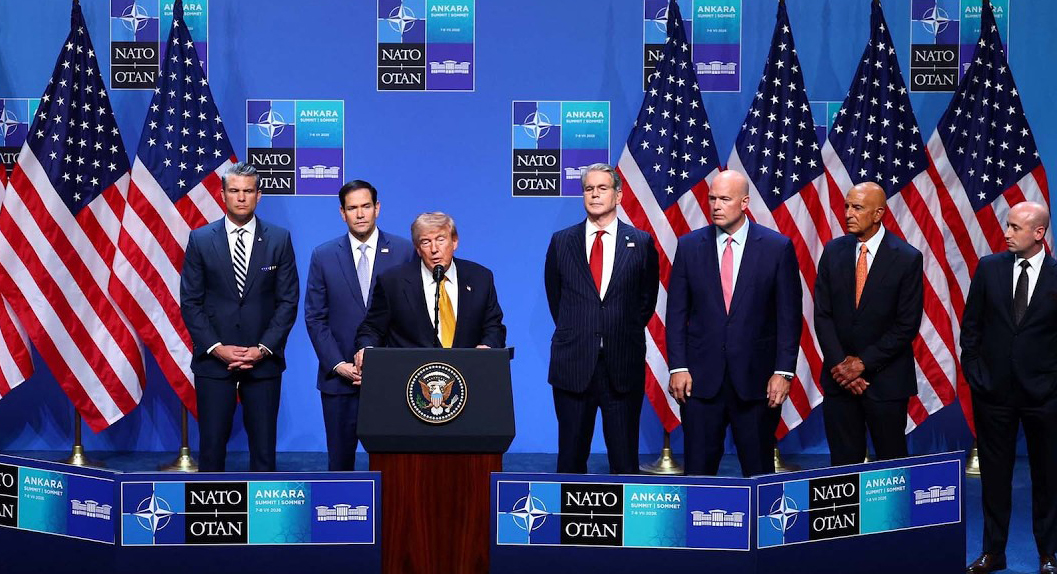
Thanks largely to the efforts of NATO Secretary General Mark Rutte, the Ankara summit passed smoothly. President Trump repeated familiar criticisms of European allies, including their past defence spending and their reluctance to give full support to the US-Israeli attack on Iran.
But this time the criticism felt formulaic rather than disruptive. There were no new Trumpian threats, and the sharper language was softened by the President’s recognition that most European allies have begun to meet his expectations on defence spending. As one participant put it, Trump was “disappointingly mellow”.
Trump had reason to be satisfied. The summit declaration formally endorsed a shift in the transatlantic burden, describing the goal as “a stronger Europe in a stronger NATO – a modernised Alliance”.
The allies also reaffirmed their determination to spend five percent of GDP on defence, security, and related infrastructure by 2035. Rutte presented evidence that Europe and Canada were ahead of schedule, with combined defence and security spending expected to average 3.93 percent of GDP in 2026.
Allies are also continuing to support Ukraine, committing $80 billion in military equipment, training and security assistance for 2026 and probably a similar amount for 2027. Some of that equipment will be bought from the United States and transferred to Ukraine, reversing what Trump regarded as President Biden’s excessive support for Kyiv.
In Trump’s own words, “There was tremendous love and unity in the room… It was a very successful NATO summit”.
On that basis, the alliance appears to have survived a political squall. Article 5 remains its clearly reaffirmed centrepiece, and NATO still presents an image of unity and purpose. Rutte’s tactics of pleasing and appeasing Trump therefore seem to be working. His main task is to keep NATO functioning as a transatlantic alliance. He recognises that the price of unity is a growing Europeanisation of NATO: Europeans are expected to carry more of the financial burden and take greater responsibility for conventional defence, especially on the eastern flank.
To manage that shift, Rutte needs time. A gradual transfer of responsibility to Europe and Canada can be planned and made credible; a sudden US withdrawal would leave dangerous gaps in NATO’s defences. For now, Rutte appears to be succeeding. The US is not, so far, withdrawing troops unilaterally, only reducing to pre-2022 levels. It is consulting allies, and NATO’s military structure is being asked to manage the transition. Yet the ground is moving beneath Rutte’s feet. However much he succeeds in keeping Trump onside, the alliance’s fundamental purpose is being quietly weakened.
What, then, is NATO’s fundamental purpose once the language of declarations, burden-sharing, and institutional reform is stripped away? In one word: deterrence. NATO’s emphasis on increasing defence spending only makes strategic sense if its ultimate aim is to deter an attack on allied territory.
During the Cold War, NATO was organised around deterrence. Its conventional and nuclear forces were trained, exercised, and visibly deployed to prevent war, not to fight one. The presence of large numbers of US and Canadian troops in Europe signalled to the Soviet Union that any aggression against Europe would automatically involve North American interests.
Seen in that light, the most important US initiative came before the summit rather than at it. In June, ahead of the Ankara summit, US Secretary of War Pete Hegseth announced a comprehensive six-month Pentagon review of America’s military footprint, troop deployments, and basing rights across Europe. Speaking to NATO defence ministers in Brussels, Hegseth framed the review as a step towards “NATO 3.0” – an alliance in which Europe takes primary and irreversible responsibility for its own conventional defence. In practice, that would mean a smaller, less visible US military presence in Europe, focused more on American global interests than on the collective defence of the continent against Russia.
“The United States is not, so far, withdrawing troops unilaterally, only reducing to pre-2022 levels. It is consulting allies, and NATO’s military structure is being asked to manage the transition. Yet the ground is moving beneath Rutte’s feet. However much he succeeds in keeping Trump onside, the alliance’s fundamental purpose is being quietly weakened.” Nicholas Williams
NATO’s force model for the defence of the NATO area calls for 300,000 high-readiness troops under SACEUR’s regional defence plans. Around 80 percent of those forces are already European or Canadian. Over time, the US share of conventional combat forces in Europe is likely to shrink even more sharply. In return, Washington would continue to affirm its commitment to nuclear deterrence in Europe. It would also keep NATO’s nuclear-sharing arrangements in place, under which about 100 US B61 nuclear gravity bombs are stored in Europe and can be delivered by allied aircraft.
The problem is that US nuclear deterrence in Europe depends on more than statements of commitment or nuclear sharing. It also relies on a significant US conventional presence that visibly shares the risks of conflict with European allies. Former British Defence Minister Denis Healey famously argued that “it takes only five percent credibility of American retaliation to deter an attack [from the Soviets], but it takes 95 percent credibility to reassure the allies”. The exact percentages matter less than the underlying point: Russia is more likely to be deterred if it believes that any attack on NATO could escalate in ways that directly involve Washington. If the US has minimal conventional troops in Europe, it has minimal stakes in the continent’s security. Why would Russia believe in US deterrence in Europe when it will have withdrawn almost all its forces? And it is difficult to see how any European country could substitute for the reassurance provided by the presence of US troops to allies exposed on NATO’s eastern flank.
Deterrence therefore becomes weaker if the US removes significant troops and capabilities from Europe. Healey’s argument assumed that American forces are visibly and steadfastly exposed to the same risks as their European allies. That was undisputably the case during the Cold War. Thus, a five percent nuclear retaliation credibility was enough to deter, because US troops would be part of the defence. Without a visibly significant US conventional presence in Europe, Russian leaders may doubt whether Washington would really escalate a European crisis to the nuclear level.
Put simply: no meaningful US conventional presence, no minimally credible NATO deterrent.
Despite the success of the Ankara summit, the US is gradually decoupling itself from Europe in ways that will have profound consequences for European security and strategic stability. NATO will not collapse in a single dramatic moment; it is slowly changing into something less able to perform its central task. If deterrence loses credibility, the alliance’s primary function of deterring war in Europe may soon become, as President Trump once said of NATO itself, obsolete.